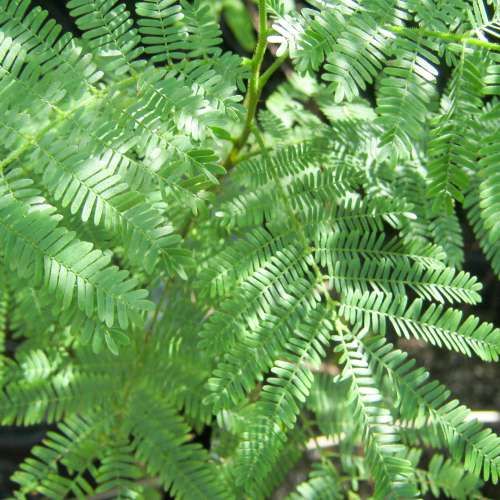
Jurema preta is a small, thorny tree with dark, deeply fissured bark, feathery twice-divided leaves and short white flower spikes. Botanists know it as Mimosa tenuiflora (Willd.) Poir., in the legume family Fabaceae. Large trees reach about 7 metres with a trunk of up to 30 cm across at chest height (Embrapa, Espécies Arbóreas Brasileiras vol. 4). Most of the measurements on this page come from that Embrapa monograph.
One tree, several names
The name you see on seed packets, Mimosa hostilis, is an older synonym. The same species has been published as Acacia tenuiflora Willd. (1806), Mimosa hostilis (Mart.) Benth. (1875) and Mimosa limana Rizzini (1974); Mimosa tenuiflora is the accepted name today.
In Brazil the common names change from state to state: jurema preta in Paraíba, Piauí and Rio Grande do Norte, plain jurema in Pernambuco, calumbi in Bahia and espinheiro preto in Ceará. Preta means black, after the dark bark. Embrapa, citing Maia (2004), derives "jurema" from jú-r-ema, "succulent thorn". In Mexico the tree is called ocozoteque, and its bark is known there as tepescohuite (Meckes-Lozoya et al. 1990).
Field marks, from trunk to seed
| Part | What to look for |
|---|---|
| Habit | often several stems from the base, an open, much-branched crown; some trees grow a single trunk |
| Trunk | straight to slightly leaning, with scattered prickles |
| Bark | up to 5 mm thick; outside dark brown, sometimes greyish, rough and split lengthwise; inside dark red |
| Twigs | reddish brown, with scattered prickles |
| Leaves | alternate, bipinnate, 4 to 7 pairs of side branches (pinnae) 2 to 4 cm long, each with 15 to 33 pairs of glossy leaflets 5 to 6 mm long |
| Flowers | very small and white, packed in single spikes 4 to 8 cm long, with a distinct scent |
| Pods | small, 2.5 to 5 cm, divided into segments, with a thin brittle wall when ripe; 4 to 6 seeds each |
| Seeds | oval, flat, light brown, 3 to 4 mm long |
The leaves look like those of many other mimosas and acacias. Embrapa, citing Silva and Sales (2008), names three features that settle it: translucent glands you can see on the underside of the tiny leaflets, a finely hairy ovary, and above all a tubular flower calyx with four prominent, curved ribs. The last two need a hand lens.
The genus Mimosa has about 480 species, around 340 of them in Brazil. Several are also called jurema, so a common name alone does not tell you which tree someone means.
Where it grows wild
In Brazil the tree grows in eight north-eastern states: Alagoas, Bahia, Ceará, Paraíba, Pernambuco, Piauí, Rio Grande do Norte and Sergipe, from about 3°45'S in Ceará to 15°S in Bahia. Outside Brazil it is recorded in Colombia, El Salvador, Honduras, Mexico (as far north as about 17°N in Oaxaca) and Venezuela. It grows from near sea level up to about 900 metres.
Its home is the Caatinga, a seasonally dry forest and scrub covering an estimated 600,000 to 900,000 km² of north-east Brazil, with 300 to 1000 mm of rain a year that usually falls within three to five months (Sampaio 1995). Within its natural range, average annual temperatures run from 23.5 to 27.2 °C and frost never occurs. The seasons page follows the tree through that year.
A tree of disturbed ground
Jurema preta is a pioneer. It prefers deep, sandy soils but asks little of them, and it thrives where land has been cleared, dug over or eroded. In some heavily altered parts of the Caatinga it is almost the only tree left. Its roots carry nodules with Rhizobium bacteria that fix nitrogen, and Embrapa recommends it for the first phase of restoring degraded land. It needs full sun and does not tolerate low temperatures.
What people use it for
- Wood. Very dense (0.86 to 1.10 g/cm³) and durable outdoors, used for fence posts, stakes, small bridges, wheels and rustic furniture. It is unsuitable for paper.
- Fuel. Firewood, and a charcoal with a high calorific value that has been used in forges and foundries.
- Fodder. Cattle and goats eat the leaves and pods; one analysis of the leafy parts found 14.6 % crude protein. A systematic review links the plant to birth defects and abortion in sheep and goats that graze it (Lima Bezerra et al. 2021).
- Bees. An important source of nectar and pollen for honey production in Ceará.
- Bark. Rich in tannins, used for dyeing and for tanning leather. See bark as a dye.
The root bark also contains DMT. That fact decides its legal status, which differs sharply between countries; see is jurema preta legal.
Seeing one for yourself
Outside the tropics you will rarely meet a mature tree, but the plant is easy to raise from seed. A seedling's first leaves are simpler than an adult's; in a Mexican study the first fully adult leaf appeared in weeks 12 to 14 (Camargo-Ricalde and Grether 1998). The growing guide covers the steps.