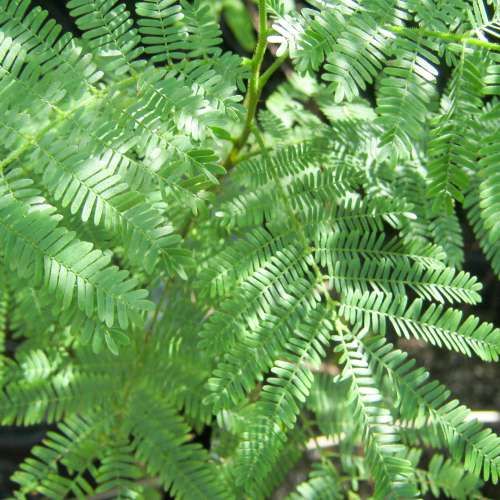
In north-east Brazil, jurema is more than the name of a tree. The anthropologist Marcus Vinícius Barreto describes it as four things at once: a group of plants in the genera Mimosa and Acacia, Mimosa tenuiflora among them; a drink made from those plants; the ceremonies in which it is taken; and the spiritual world those ceremonies open onto (Barreto 2019, Enciclopédia de Antropologia, Universidade de São Paulo). The tradition lives on in Indigenous communities and in Afro-Brazilian religions of the region.
This page describes the tradition as anthropologists and lawmakers have recorded it. It does not describe how the drink is made or taken, and nothing here is an invitation to try it.
Indigenous jurema and the Toré
Several Indigenous peoples of the north-east use jurema in their rituals. A review in the Brazilian Archives of Biology and Technology lists names for the drink among them: "jurema wine" for the Truká and Kambiwá, ajucá for the Pankararu, anjucá for the Atikum and Kambiwá. Among the Kariri-Xocó, gathering the bark is reserved for initiated members. Tobacco and candles appear in almost all of these rituals, which are practised today in a gathering called the Toré (Souza et al. 2008).
Barreto notes that jurema has also become a marker of identity: for Indigenous groups seeking state recognition as traditional peoples, it stands for a mythical and ritual world of Indigenous origin. In their ceremonies, contact is made with the Encantados, the enchanted beings. The anthropologist Rodrigo de Azeredo Grünewald wrote about jurema among the Atikum in Toré e jurema (2008).
Afro-Brazilian jurema, catimbó and Jurema Sagrada
In the cities of the north-east, jurema became part of Afro-Brazilian religious life. In the first half of the twentieth century its practice in Natal and Recife was known as catimbó. The spirits are mestres and mestras, masters and mistresses, and initiates build a relationship with a spirit through spaces called cidades, the "cities" of jurema. René Vandezande studied the Acaes family of Alhandra in Paraíba in 1975, and jurema in the Umbanda temples of that state, whose ceremonies resemble Umbanda gatherings. Today the name Jurema Sagrada is common.
Across Indigenous and Afro-Brazilian practice, Barreto lists four elements that appear in nearly every ceremony: the drink, smoke from pipes, the maracá rattle and songs.
One figure stands out in recent writing. Malunguinho was the name of a leader of the Quilombo do Catucá, a community of people who had escaped slavery, in the nineteenth century, and is also the name of a spirit in the jurema pantheon. Alexandre L'Omi L'Odò gave him new visibility in Juremologia (2017).
How the tradition was written down
| Year | Who | What |
|---|---|---|
| 18th century | colonial documents | Guilherme Medeiros (2006) reads them as evidence that jurema was already in use |
| 1933 | Mário de Andrade | lecture on the songs of catimbó, "Música de feitiçaria no Brasil" |
| 1937 and 1938 | Gonçalves Fernandes | studies of catimbó in Recife |
| 1945 | Roger Bastide | describes a catimbó ceremony and argues for an Indigenous origin |
| 1946 | Gonçalves de Lima | isolates an alkaloid he calls nigerine from the root bark used by the Pankararu |
| 1969 and 1978 | Luís da Câmara Cascudo | sees catimbó as a meeting of Iberian sorcery, Indigenous plant knowledge and Bantu music |
| 2008 | Rodrigo de Azeredo Grünewald | Toré e jurema, on the Atikum |
The table follows Barreto (2019); the 1946 entry follows Souza et al. (2008), who note that nigerine was later suggested to be an impure form of DMT.
Protected by law in Paraíba
In 2025 the state of Paraíba recognised Jurema Sagrada as part of its intangible cultural heritage in law nº 13.760 (text of the law, Assembleia Legislativa da Paraíba). The law is short: it declares the recognition and sets the date it takes effect.
That status protects a religious and cultural practice. It does not change the status of DMT under drug law, in Brazil or anywhere else.
The tree behind the name
Underneath the tradition stands an ordinary tree of the Caatinga: thorny, tough, flowering in the dry months, and useful for fence posts, firewood and fodder. Read how to recognise it, how it moves through the seasons, and how to grow one from seed as an ornamental. The bark's older and more everyday use, as a dye and tanning material, is on bark as a dye.