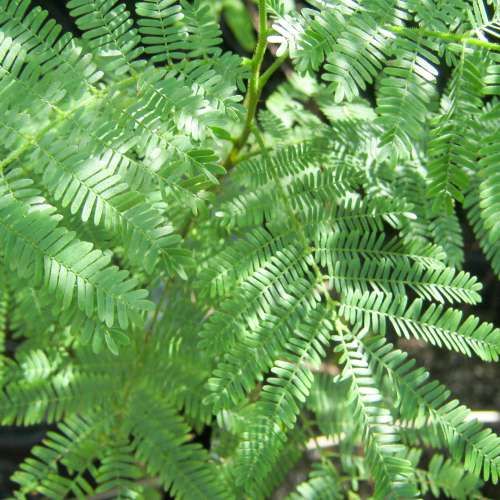
Jurema preta follows the rain. In the Caatinga, the dry forest of north-east Brazil, most of the year's rain falls in three to five months, and the tree loses much of its foliage in the long dry season, flowers and sets seed while it is dry, and leafs out again once the rains begin. Embrapa classes it as semi-deciduous: it rarely ends up completely bare, and it keeps green fodder longer into the drought than many neighbours (Embrapa).
A forest shaped by short, erratic rains
The Caatinga covers an estimated 600,000 to 900,000 km² of north-east Brazil. Annual rainfall is 300 to 1000 mm, usually concentrated in three to five months and very erratic from year to year (Sampaio 1995). A Brazilian forestry paper summarises the semi-arid region as about 800,000 km², with around 500 mm of poorly distributed rain and temperatures between 18 and 40 °C, and describes its vegetation as trees and shrubs that drop their leaves in the drought, often armed with thorns or prickles, with cacti, bromeliads and annual herbs (Azevêdo et al. 2014).
Within the range of jurema preta, Embrapa gives annual rainfall from 380 mm in Paraíba to 1650 mm in Ceará, average annual temperatures of 23.5 to 27.2 °C, and no frost anywhere. The lowest temperature on record in its range is 10.1 °C, measured at Paulo Afonso in Bahia on 11 December 1971.
One year, measured
Azevêdo and colleagues sampled jurema preta at Santa Terezinha in Paraíba, a site with about 600 mm of rain a year, every three months from August 2008 to August 2009. They recorded the share of the trees with green leaves, dry leaves, flowers and ripe fruit.
| Month | Season | Green leaves | Dry leaves | Flowers | Ripe fruit |
|---|---|---|---|---|---|
| August 2008 | start of the dry season | 30 % | 70 % | 0 % | 0 % |
| December 2008 | start of the rains | 80 % | 0 % | 0 % | 0 % |
| April 2009 | end of the rains | 100 % | 0 % | 10 % | 0 % |
| August 2009 | dry season again | 20 % | 20 % | 40 % | 60 % |
The authors link the leaf loss to the density of the wood: species with dense wood are more sensitive to water stress and shed their leaves as the soil dries. In December they found fresh young leaves; in April, many green leaves and the first flower buds; in the following August, few green leaves and a large crop of ripe pods. That is the season in which the seed is dispersed.
Flowering in the dry months
The flowering season depends on the region. Embrapa gives July to February in Pernambuco and September to January in Ceará, with fruit ripening from December to March and February to April respectively. The paper from Paraíba, citing Maia (2004), puts the normal flowering period at August to November, in the heart of the dry season. The small white flowers are pollinated mainly by bees and other small insects, and the tree is a recognised source of nectar and pollen for honey in Ceará.
The ripe pods are thin and brittle. Embrapa describes seed dispersal mainly by gravity. In Mexico, Camargo-Ricalde and Grether found pods and seeds carried by the wind within 5 to 8 metres of the parent tree, and washed downhill by rain (Rev. Biol. Trop. 46(3), 1998).
The two seasons side by side
| Dry season | Rainy season | |
|---|---|---|
| Crown | thin, partly bare, many dry leaves | dense, fresh green, feathery |
| Flowers | the main flowering months in Paraíba | first buds near the end of the rains |
| Pods | ripen, split and drop seed | mostly absent |
| For animals | one of the trees that still offers green fodder | abundant fodder everywhere |
| For the soil | leaf litter on the ground | new growth, root nodules fixing nitrogen |
Use the switch at the top of the page to see the same forest in each state.
What the rhythm means for a tree in a pot
A tree adapted to this calendar has no use for a European winter. It needs warmth and full sun to grow, and frost is outside anything it meets at home. Two practical rules follow:
- Keep it warm. The coldest temperature recorded in its natural range is 10.1 °C. Keeping a potted tree above that is a cautious working minimum; we found no published test of how much colder it can survive.
- Expect slow months. A sun-loving tree grows little in the short, dull days of a northern winter. Water sparingly while growth is slow, so the compost does not stay cold and wet.
The full care plan, from scarifying the seed to the first winter, is in the growing guide. For identification features in each season, see the tree.