Jurema preta bark colours cloth and tans leather because it is full of tannins. A Brazilian study measured 17.74 % condensed tannins in the stem bark and called it suitable for the leather and tanning industries (Paes et al. 2006, cited in Azevêdo et al. 2014). Its extract is used as a colorant in the textile and leather industries.
Why tree bark dyes at all
In tree bark, most of the compounds that give colour are tannins. That was the finding of a review by the Instituto de Pesquisas Tecnológicas in São Paulo, which collected 21 native Brazilian tree species whose bark can serve as a textile dye (IPT 2021).
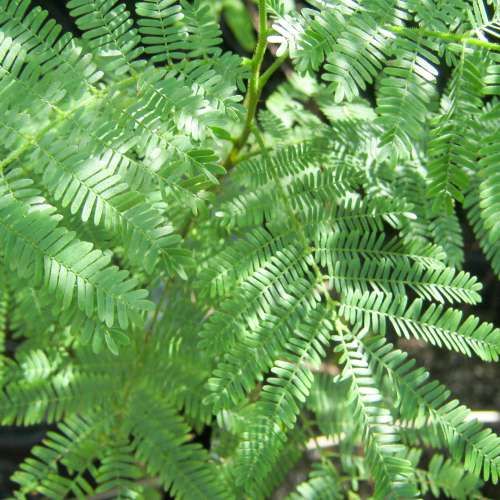
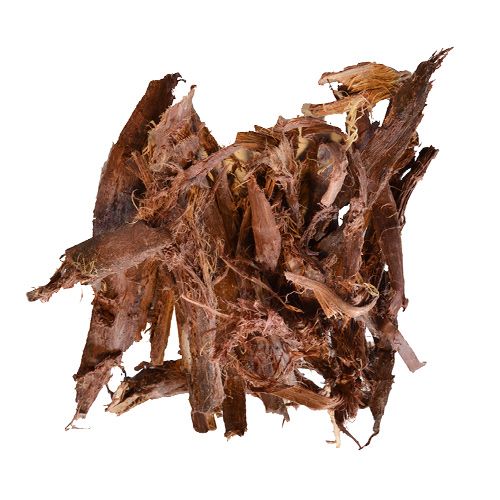
Jurema preta has a lot of them. The bark is up to 5 mm thick, dark brown and fissured outside and dark red inside (Embrapa). A review of the species notes that its tannins are used in paints and for tanning (Souza et al. 2008).
What a laboratory test found
Erkan, Şengül and Kaya dyed two kinds of cotton with a Mimosa tenuiflora extract: plain white cotton and cotton already dyed with indigo. They treated the fabrics with six different metal salts as mordants and measured colour and fastness (Journal of Saudi Chemical Society 18(2), 2014). According to the abstract:
- the extract is used in the food industry as an additive and in the textile and leather industries as a colorant;
- the nickel mordant gave the most saturated colours;
- fastness to washing, rubbing and light was moderate overall;
- wet rubbing fastness on the indigo cotton was poor, which the authors put down to indigo itself.
We have read the abstract, not the full paper, so we do not quote individual shade names or numbers from it. Nickel salts are an industrial mordant and not a sensible choice for a home dye pot.
Colours and mordants, as the shop describes them
Avalon Magic Plants sells inner root bark of the tree and describes its use as a dye on the product page. In the shop's words the bark gives shades "ranging from soft pink to deep purple and reddish-brown", with the final colour depending on the mordant (alum, iron or copper) and the material; alum gives warmer tones, iron darker tones and copper greenish undertones. The shop lists cotton, linen, wool, silk, hemp, leather, paper and wood as suitable materials, and the page includes basic dyeing steps.
The shop also describes the bark for vegetable leather tanning, and as a botanical specimen for collectors. It sells the bark whole, imported from Brazil, and advises storing it cool, dry and dark, away from direct sunlight to keep its colour.
Who the bark is offered to
The root bark contains DMT. In 24 samples of inner bark from Bahia, Gaujac and colleagues measured 1.26 to 9.35 mg of DMT per gram (J Chromatogr B, 2012). DMT is a controlled substance in every country this site covers. Whether bark that contains it is legal depends on the country:
- Netherlands. The plant and its bark are not on any list of the Opium Act, and DRUGSinfo states that plants containing DMT may be imported legally. The bark on this page is offered for a stay in the Netherlands, to adults, as a dye material and specimen.
- United Kingdom. The legal position of the bark is uncertain and the Court of Appeal has said so. Do not order it to the UK.
- United States. Federal law covers any material that contains any quantity of DMT. Do not order it to the US.
- France and Germany. France lists Mimosa hostilis as a narcotic plant; in Germany, plant parts containing DMT are controlled when intended for intoxication. Do not order it there.
Details, dates and sources for each country are on the legal page.
The shop states that the bark "is not sold or intended for the purpose of human consumption". This site gives no instructions for extracting anything from the bark or preparing it for use as a drug, and links to no such information.
Practical care in the dye workshop
- Tannin dyes stain hands, wooden spoons and worktops. Wear gloves and use pots you keep for dyeing only.
- Keep bark, dye baths and offcuts away from children and animals. Leaves and pods of the tree are known to cause birth defects in grazing sheep and goats (Lima Bezerra et al. 2021).
- Test a mordant on a small skein before you dye a whole batch. Colour depends on fibre, water and mordant, and the published test above found only moderate fastness.
Growing your own source
A tree in a pot is not a practical source of bark. If what draws you is the tree itself, start from seed: the growing guide shows how, and the field marks help you follow its development.